I, Medusa by Ayana Gray is a Greek mythology retelling featuring Medusa, one of three daughters of Phorcys and Ceto, who were famed as the “Gorgons”, meaning they could calcify people with just a look.
Often written as a “monster” or demonised for her actions, some versions of the Greek myth of Medusa paint her as a monster, whilst some give credence to how and why she became that way.
Ayana Gray’s version delves into her background origins with her family, notably reimagining her with a beautiful head of locs when she was a mortal young adolescent, before she was “transformed”.
It’s a powerful retelling, and one that captures some of the most timely themes of the realities we live in today. In saying that, please be mindful of the I, Medusa trigger warnings, which I’ve listed in extensive detail below, as they’re quite heavy and may be triggering.
Apart from that, if that sounds like something you might be interested in, I wrote a wee little blog post and I, Medusa book review covering the characters and Greek gods that appear, the synopsis and answered some FAQs.
As always, happy reading friends!
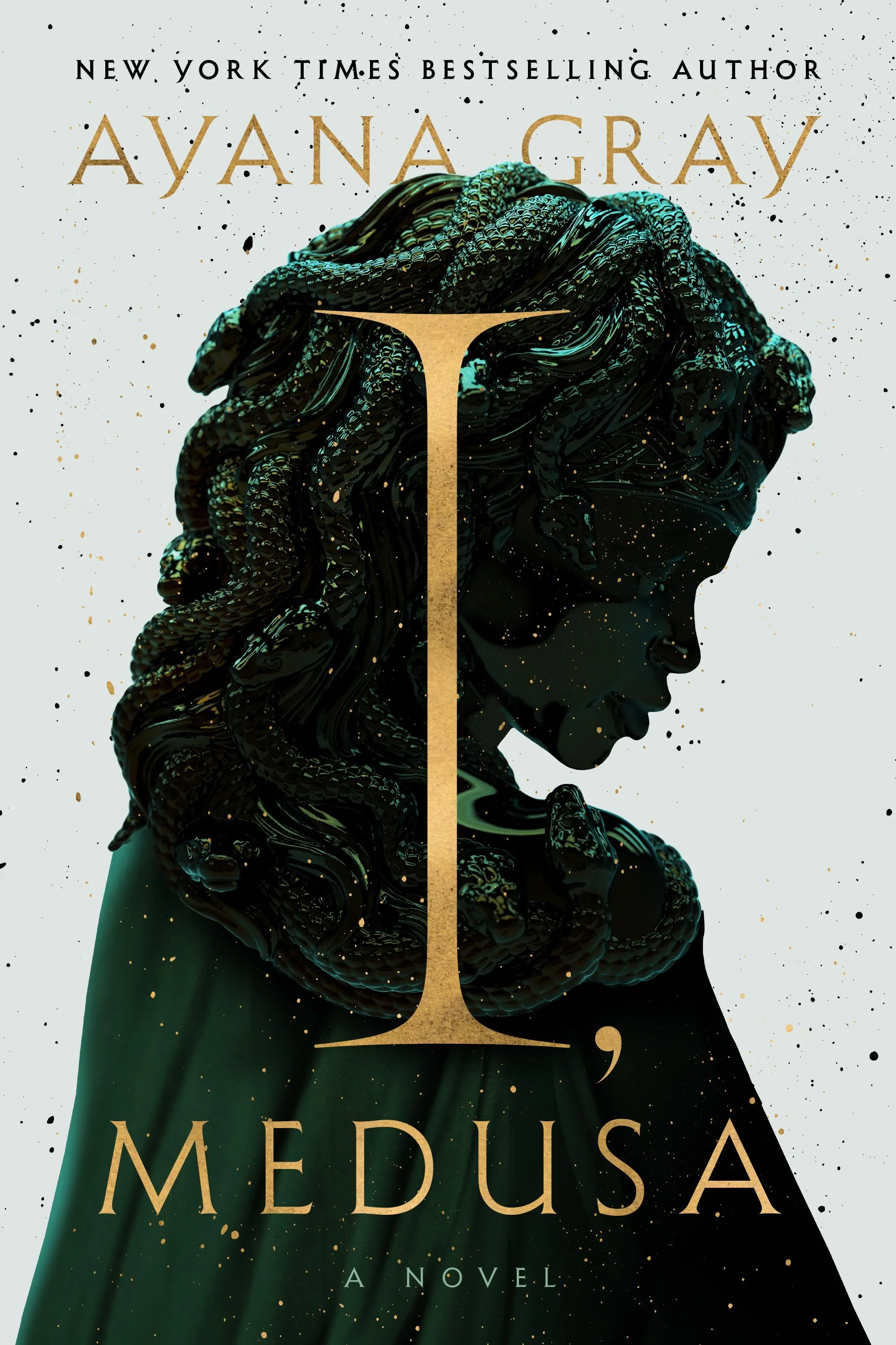
I, Medusa synopsis.
From bestselling author Ayana Gray comes a new kind of villain origin story, reimagining one of the most iconic monsters in Greek mythology as a provocative and powerful young heroine.
Meddy has spent her whole life as a footnote in someone else’s story. Out of place next to her beautiful, immortal sisters and her parents—both gods, albeit minor ones—she dreams of leaving her family’s island for a life of adventure. So when she catches the eye of the goddess Athena, who invites her to train as an esteemed priestess in her temple, Meddy leaps at the chance to see the world beyond her home.
In Athens’ colorful market streets and the clandestine chambers of the temple, Meddy flourishes in her role as Athena’s favored acolyte, getting her first tastes of purpose and power. But when she is noticed by another Olympian, Poseidon, a drunken night between girl and god ends in violence, and the course of Meddy’s promising future is suddenly and irrevocably altered.
Her locs transformed into snakes as punishment for a crime she did not commit, Medusa must embrace a new identity—not as a victim, but as a vigilante—and with it, the chance to write her own story as mortal, martyr, and myth.
Exploding with rage, heartbreak, and love, I, Medusa portrays a young woman caught in the cross currents between her heart’s deepest desires and the cruel, careless games the Olympian gods play.
Get I, Medusa here.
I, Medusa characters.
Character art shared by author @ayanagray_ via Instagram. Artist 🎨: @marymetzgr
Main characters.
I, Medusa is told in first-person narrative from the perspective of Medusa.
Medusa.
Medusa, in Ayana Gray’s retelling lives on a remote island somewhere faraway from Athens, with her family:
Ceto (Medusa’s mother and a goddess of the sea)
Phorcys (father)
Stheno (sister)
Euryale (sister)
Theo is Meddy’s best friend who washed up on the island and worked as a slave for Medusa’s family and their friendship is precious.
Other supporting characters.
Theo (Medusa’s best childhood friend)
Prince Maheer
Eupraxia
Apollonia
Kallisto
Amersa
Galene
Xanthe
Athena
Poseidon
Queen Amphitrite
Hermes
Kallinikos
Christos
Haris
Platon
Zeus
Linus of Argos
Sobekemsaf
Ephemia
Glaukopis (owl)
Gods, goddesses and famous mythological beings who appear or are mentioned in I, Medusa.
A few gods, goddesses and mythological creatures appear in Medusa’s story, some make cameos, and some are only mentioned in passing. Here is the full list.
Ceto
Phorcys
Zeus
Athena
Hermes
Poseidon
Queen Amphitrite
Hera
Ares
Tethys
Nereus
Helios
Eurybia
Thaumas
Oceanus
Deino
Enyo
Pemphredo
Echidna
Ladon
Demeter
Hades
Artemis
Dionysus
Selene
Morpheus
Hephaestus
Review: I, Medusa by Ayana Gray.
View my review and follow me on GoodReads here.
Zeus hurls lightning bolts, Artemis has flawless aim and Poseidon waves a trident around like he’s overcompensating for something probably. Cool I guess. But do any of them have snake hair and a gaze that can turn you to stone? Yeah, nah.
But while Medusa may be famed for her hissing hair and looks that literally kill, her story is one of the most tragic.
What really gets under my skin is the way her story embodies what happens when a girl is groomed, gaslit, sexually assaulted, victim-blamed and then transformed and framed as a monster while predatory Greek gods face zero consequences and still get worshipped like they’re flawless.
It made me feel a lot of emotions ranging from devastation to fury. Maybe it's because Medusa's story feels timely and simultaneously, exhaustingly familiar...
In my opinion, Medusa was never the monster. She was just a seventeen year old mortal who was demonised for violence inflicted upon her by an immortal dude. I applaud Ayana Gray for a powerful reclamation of one of Greek mythology’s most misunderstood people, retelling Meddy’s story with righteous fury, tenderness and the cultural relevance it always deserved.
I'm sure Greek mythology veterans are aware that the gods were, frankly, a pack of predatory, misogynistic, narcissistic, groomers, creeps and pedos and if they were real people they would probably run in the same circle as that Epstein guy and that orange fella.
Moreover, there’s the underlying metaphor of mortals worshipping heinous, callous, flawed gods in the same cringe way people today worship celebrities and politicians, who in reality are just people who should be held accountable for their actions.
But I digress.
Anyway, Gray reframes Medusa as a symbol of everything women have survived despite systems designed to crush them, and her reclamation of Medusa’s story is here to make you reflect, rage and remind you that "monsters" aren't born, they're made.
I, Medusa is now my favourite Greek mythology retelling I have ever read, overtaking the ranks of my beloved Miller’s Circe and Song of Achilles and a few others. I think if you have ever been fascinated by Medusa and Greek mythology retellings, you will probably resonate with this and I HIGHLY RECOMMEND. But for the love of the Gorgons, please mind your triggers loves.
If you’re a Poseidon, Zeus or Athena apologist (I’m so very sorely disappointed in Athena), maybe sit this one out.
My heartfelt thanks to NetGalley, Bonnier Books UK | Zaffre & Ayana Gray for the ARC.
Trigger warnings I caught, but aren't limited to: Sexual predators, domestic abuse, slavery, alcoholism, animal cruelty, racism, xenophobia, colonisation, rape, sexual assault, child SA, grooming, gaslighting, PTSD, misogyny.
View my review and follow me on GoodReads here. I chat about books a lot.
I, Medusa FAQs.
SPOILER ALERT:
⚠️ Some answers may spoil I, Medusa if you haven’t read it already. Proceed with caution. ⚠️
Here are the answers to all your common FAQs.
Is I, Medusa a series?
No, I, Medusa is a standalone Greek mythology retelling.
What are the content and trigger warnings?
Violence
Murder
Religious hypocrisy
Death
Toxic family relationships
Injury details
Classism
Nepotism
Grief
Gore
Sexual assault and rape
Pedophilia
Grooming
Misogyny
Domestic abuse
Alcoholism
Racism
Xenophobia
Animal death
Colonisation
Gaslighting
PTSD
Enjoyed reading I, Medusa by Ayana Gray? You may also enjoy reading:
Circe by Madeline Miller
Fallen City by Adrienne Young
The Possession of Alba Diaz by Isabel Cañas
Hera by Jennifer Saint